
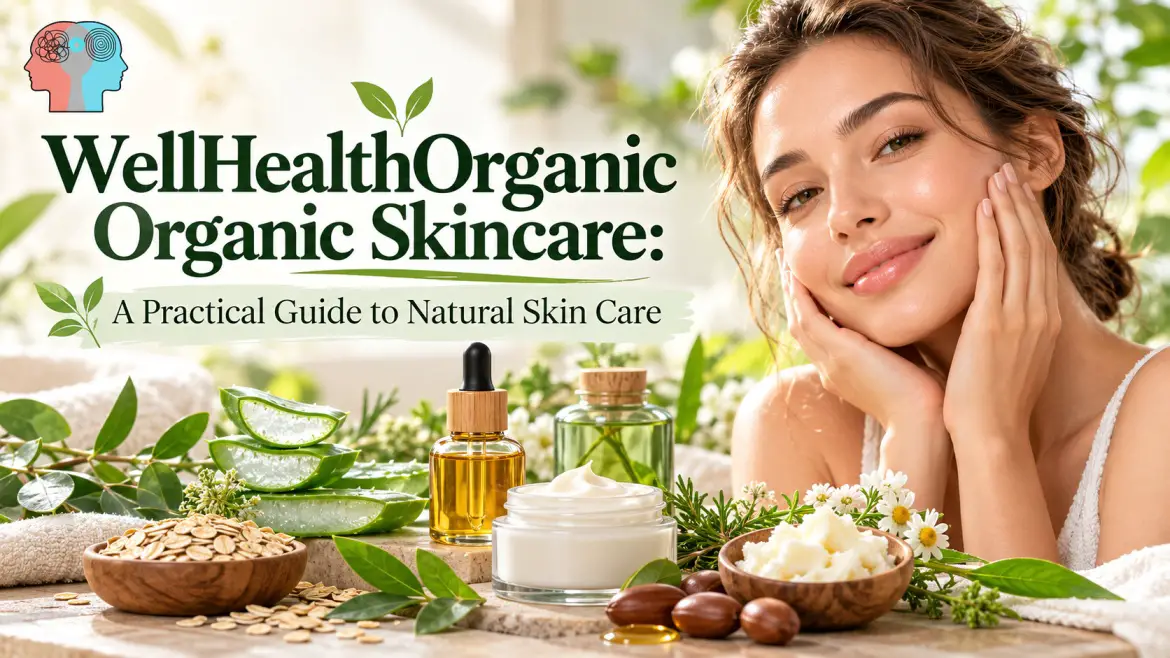
WellHealthOrganic organic skincare is a search term commonly used by people looking for natural, plant-based, organic, or simpler approaches to skin care.
But good skincare is not as simple as replacing every “synthetic” ingredient with a natural one.
Organic skincare can include ingredients such as:
- Aloe vera
- Jojoba oil
- Shea butter
- Oat
- Green tea
- Plant oils
- Botanical extracts
However, an ingredient being natural or organic does not automatically make it safer, gentler, more effective, or better for every skin type.
The U.S. Food and Drug Administration specifically explains that the source of an ingredient does not determine its safety. Plants can also contain substances that irritate the skin or cause allergic reactions. (FDA)
The best skincare routine—organic or otherwise—is usually one that is:
- Simple
- Consistent
- Appropriate for your skin type
- Gentle enough to protect the skin barrier
- Supported by sunscreen
- Adjusted when irritation occurs
Quick Answer
A practical organic skincare routine does not need 10 different products.
For most people, a strong daily routine starts with:
Morning
- Gentle cleanser if needed
- Moisturizer suited to your skin
- Broad-spectrum SPF 30 or higher
Evening
- Gentle cleanser
- Treatment product if needed
- Moisturizer
Organic or plant-derived ingredients can be included if your skin tolerates them.
The label organic should not replace more important questions such as:
-
Is the product appropriate for my skin type?
-
Does it contain fragrance?
-
Is it likely to clog my pores?
-
Does it have a safe preservative system?
-
Is the sunscreen properly tested?
-
Does my skin tolerate it?
What Does “WellHealthOrganic Organic Skincare” Mean?
“WellHealthOrganic organic skincare” is not a distinct medical skincare system.
People generally use the phrase when searching for skincare based around:
- Natural ingredients
- Organic products
- Herbal skincare
- Minimalist routines
- DIY skin remedies
- Plant oils
- Ayurveda-inspired skincare
- Fewer heavily fragranced or irritating products
Some of these approaches can fit into a healthy skincare routine.
Others require more caution.
The most useful way to approach the subject is to separate marketing terminology from actual skin needs.
What Is Organic Skincare?
Organic skincare generally refers to cosmetic products containing ingredients derived from agricultural sources that were grown or produced according to organic standards.
Examples might include organically grown:
- Aloe vera
- Coconut
- Jojoba
- Sunflower
- Shea
- Herbs
- Botanical oils
But the meaning of “organic” on cosmetic labels is more complicated than it is on food labels.
Does the FDA Define “Organic” Cosmetics?
No.
The FDA states that it does not define the term “organic” for cosmetics.
In the United States, organic agricultural claims are primarily overseen through the U.S. Department of Agriculture’s National Organic Program.
A cosmetic may therefore need to comply with both:
- USDA rules regarding organic agricultural claims
- FDA rules regarding cosmetic safety and labeling
The FDA explains this distinction in its official guidance on organic cosmetics.
Does “Organic” Mean 100% Organic?
Not necessarily.
Labels can refer to organic content in different ways depending on applicable certification standards and the percentage of qualifying organic agricultural ingredients.
A product may contain one organic ingredient without the entire formula being organic.
For example, a moisturizer might contain:
- Organic aloe vera
- Water
- Humectants
- Emulsifiers
- Preservatives
- Fragrance
Seeing “organic aloe” on the front label does not tell you everything about the finished formulation.
Always read the full ingredient list.
Organic vs. Natural Skincare
These terms are often incorrectly treated as identical.
They are not.
Organic
Usually relates to how qualifying agricultural ingredients were produced.
Natural
Generally suggests that ingredients come from naturally occurring sources.
However, FDA does not have a regulatory definition for natural in cosmetic labeling.
Plant-Based
Means that some ingredients are derived from plants.
Clean Beauty
This is largely a marketing term rather than a standardized medical or regulatory category.
Different brands define “clean” differently.
One company may exclude:
- Parabens
while another may exclude:
- Silicones
- Mineral oil
- Sulfates
- Synthetic fragrance
- Certain preservatives
There is no single universal definition.
Is Organic Skincare Better Than Regular Skincare?
Not automatically.
The FDA states clearly that an ingredient being organic does not make it inherently safer.
A synthetic ingredient can be:
- Effective
- Stable
- Well tested
- Non-irritating
while a botanical ingredient can cause:
- Irritation
- Allergy
- Photosensitivity
- Contact dermatitis
The question should therefore not be:
Natural or chemical?
A more useful question is:
Is this formulation safe, appropriate, effective, and well tolerated by my skin?
Everything—including water, plant oils, vitamins, and skin—is made of chemicals.
“Chemical-free skincare” is therefore not a scientifically meaningful concept.
Does Natural Mean Hypoallergenic?
No.
This is one of the biggest organic skincare misconceptions.
The American Academy of Dermatology specifically notes that natural products can still trigger allergies and irritation, particularly in sensitive skin.
Dermatologists even caution that people with sensitive skin can react to botanical ingredients frequently found in organic skincare. (American Academy of Dermatology)
Natural substances that may trigger reactions include:
- Essential oils
- Fragrance
- Citrus extracts
- Certain flowers
- Tree-derived ingredients
- Nut oils
- Plant resins
Poison ivy is natural too.
Natural origin alone is not a safety guarantee.
Understanding Your Skin Before Choosing Products
Before building any organic skincare routine, identify your skin type.
Common categories include:
- Normal
- Dry
- Oily
- Combination
- Sensitive
- Acne-prone
Some people fit into more than one category.
For example, someone can have:
oily + sensitive + acne-prone skin
at the same time.
Normal Skin
Normal skin usually feels relatively balanced.
It may have:
- Minimal oiliness
- Minimal dryness
- Few sensitivity problems
A basic routine may be enough.
Dry Skin
Dry skin may feel:
- Tight
- Rough
- Flaky
- Itchy
The priority is supporting the skin barrier and reducing moisture loss.
Look for moisturizers containing ingredients such as:
- Ceramides
- Glycerin
- Hyaluronic acid
- Shea butter
- Petrolatum
- Squalane
Organic oils can sometimes help, but oil alone does not replace every function of a well-formulated moisturizer.
The American Academy of Dermatology notes that moisturizers work by adding moisture and helping prevent water from leaving the skin. (AAD)
Oily Skin
Oily skin produces more sebum and may appear:
- Shiny
- Greasy
- More prone to clogged pores
Having oily skin does not mean you should strip it aggressively.
Over-cleansing or using harsh products can irritate the skin barrier.
Choose:
- Gentle cleanser
- Lightweight moisturizer
- Non-comedogenic products
- Appropriate acne treatments if needed
Avoid assuming that strong herbal ingredients such as neem or tea tree oil are automatically better because they are natural.
They can irritate some skin types.
Combination Skin
Combination skin commonly involves:
- Oily forehead, nose, or chin
- Drier cheeks
You may not need the same amount of moisturizer everywhere.
AAD dermatologists note that different areas of the face may require different levels of moisturizing. (AAD)
Sensitive Skin
Sensitive skin may:
- Sting
- Burn
- Flush
- Become itchy
- Develop rashes after products
For sensitive skin, fewer ingredients are often better.
Look for:
- Fragrance-free formulas
- Gentle cleansers
- Simple moisturizers
- Limited botanical extracts
A product labeled “organic” can still be too irritating.
Acne-Prone Skin
Acne-prone skin benefits from avoiding products likely to clog pores.
Look for labels such as:
- Non-comedogenic
- Won’t clog pores
Acne can involve:
- Blackheads
- Whiteheads
- Pimples
- Nodules
- Cysts
Moderate or severe acne should not be treated only with DIY masks.
A dermatologist can recommend evidence-based treatments.
A Simple WellHealthOrganic Organic Skincare Routine
The strongest skincare routine is often simpler than social media suggests.
The American Academy of Dermatology recommends core basics that include:
- Cleansing
- Moisturizing
- Sun protection
(AAD)
Morning Routine
Step 1: Cleanse Gently
Use a mild cleanser if your skin needs morning cleansing.
Some people with very dry skin may prefer simply rinsing with water in the morning.
Avoid cleansers that leave your face feeling:
- Extremely tight
- Burning
- Dry
- Squeaky
That sensation is not proof that the skin is cleaner.
Step 2: Apply a Treatment if Needed
Treatments depend on your individual concern.
Possible concerns include:
- Acne
- Hyperpigmentation
- Redness
- Fine lines
- Dryness
Do not add a treatment simply because it is trending.
Step 3: Moisturize
Moisturizer helps reduce water loss.
Useful moisturizing ingredients may include:
- Glycerin
- Hyaluronic acid
- Ceramides
- Shea butter
- Squalane
- Jojoba oil
The ideal texture depends on your skin type.
Oily skin may prefer:
- Gel
- Lightweight lotion
Dry skin may prefer:
- Cream
- Ointment
Step 4: Use Sunscreen
This is one of the most important skincare steps.
Use a:
broad-spectrum, water-resistant SPF 30 or higher
when exposed to daylight.
The American Academy of Dermatology emphasizes sunscreen as an important part of daily skincare for reducing UV damage, premature aging, and skin cancer risk. (AAD)
Do not let an “all-natural” skincare routine cause you to skip effective sun protection.
Evening Routine
Step 1: Remove Makeup and Sunscreen
If you wear makeup or water-resistant sunscreen, remove it gently.
Step 2: Cleanse
Use a gentle cleanser to remove:
- Oil
- Sweat
- Dirt
- Makeup residue
- Sunscreen residue
AAD generally recommends limiting face washing to about twice daily and after sweating to reduce unnecessary irritation. (AAD)
Step 3: Apply Treatment
If you use treatment products, nighttime can be appropriate for some of them.
Follow product instructions carefully.
Step 4: Moisturize
Apply moisturizer while the skin is slightly damp when appropriate.
This can help trap water in the skin.
Best Organic and Plant-Derived Ingredients to Consider
Not every botanical ingredient has equal evidence.
Some can be useful within well-formulated products.
Aloe Vera
Aloe vera is widely used in skincare for its cooling and soothing feel.
It may be found in:
- Gels
- Moisturizers
- After-sun products
However, aloe can still cause irritation or allergic reactions in some people.
Use a properly formulated product rather than assuming fresh plant gel is sterile or automatically safer.
Oat
Colloidal oatmeal is commonly used in products for:
- Dry skin
- Sensitive skin
- Itching
It can be a useful ingredient in gentle moisturizers and bathing products.
Shea Butter
Shea butter works primarily as an emollient.
It can help make dry skin feel:
- Softer
- Smoother
It is particularly common in:
- Body creams
- Hand products
- Lip products
Jojoba Oil
Jojoba is technically a wax ester and is frequently used in cosmetic formulations.
It can function as an emollient and may help soften skin.
That does not mean it is identical to human sebum or appropriate for everyone.
Sunflower Seed Oil
Sunflower seed oil appears in many moisturizers.
It can serve as an emollient within barrier-supporting formulations.
Green Tea
Green tea contains polyphenols and is used in many skincare formulations.
Research continues into its antioxidant and anti-inflammatory properties.
It should be viewed as a supportive skincare ingredient rather than a cure for skin disorders.
Honey
Honey has antimicrobial properties under certain conditions and is used medically in specially prepared wound products.
That does not mean raw grocery-store honey should be used to treat:
- Infected wounds
- Severe acne
- Eczema
- Open skin lesions
Medical-grade honey and household honey are not interchangeable.
Turmeric
Turmeric contains curcumin and has been studied for anti-inflammatory activity.
However, rubbing kitchen turmeric directly onto the face can:
- Stain skin
- Irritate some people
- Cause contact reactions
A cosmetic formulation is usually more predictable than an improvised kitchen mixture.
Rosehip Oil
Rosehip oil is commonly marketed for:
- Dryness
- Fine lines
- Scars
- Pigmentation
It can function as an emollient.
Evidence for dramatic scar or pigmentation removal is much weaker than marketing claims often imply.
Coconut Oil
Coconut oil is useful as an emollient in some contexts, particularly for body skin.
However, it can feel heavy and may not suit acne-prone facial skin.
A product being edible does not automatically make it the ideal facial cosmetic.
Essential Oils: Natural but Not Risk-Free
Essential oils are one of the areas where “natural = safe” assumptions create problems.
FDA notes that plant-derived essential oils may cause:
- Irritation
- Allergic reactions
- Toxic effects
- Photosensitivity
Certain citrus oils can be especially problematic when exposed to sunlight. (FDA)
Be cautious with ingredients such as:
- Lemon oil
- Lime oil
- Bergamot
- Peppermint oil
- Cinnamon oil
- Clove oil
- Tea tree oil
especially when applied undiluted.
Should You Use Lemon Juice on Your Face?
Generally, it is better not to.
Lemon juice is acidic and can irritate skin.
Citrus-related compounds can also interact with sunlight and contribute to skin reactions.
Using lemon juice directly on the face for:
- Dark spots
- Acne
- “Brightening”
is much less predictable than using a properly formulated skincare product.
Is Baking Soda Good for Skin?
Usually not as a routine facial treatment.
Baking soda is alkaline and can disrupt the skin’s normal surface environment.
It may cause:
- Dryness
- Irritation
- Barrier disruption
There is little reason to use it when gentler cleansers are readily available.
Is Apple Cider Vinegar Good for the Face?
Concentrated apple cider vinegar can irritate or burn skin.
It should not be treated as a universal natural toner.
A product being natural or commonly found in the kitchen does not make it suitable for direct facial application.
DIY Organic Skincare: What You Should Know
DIY skincare sounds appealing because it feels:
- Fresh
- Simple
- Natural
- Affordable
But homemade cosmetics have limitations.
Homemade Products Can Become Contaminated
A DIY product containing:
- Water
- Aloe gel
- Rose water
- Fruit
- Herbal infusions
can support microbial growth if it lacks an adequate preservative system.
Refrigeration does not turn an unpreserved mixture into a professionally preserved cosmetic.
“Preservative-Free” Is Not Always Better
Preservatives are often portrayed negatively in natural beauty marketing.
But preservatives serve an important function:
preventing microbial growth.
A contaminated cosmetic may be more dangerous than an appropriately preserved one.
Avoid Storing DIY Water-Based Products
Making large batches of homemade:
- Toners
- Sprays
- Aloe mixtures
- Herbal waters
and storing them for days or weeks is not ideal unless preservation and contamination control are properly understood.
A commercial formulation is usually more stable.
Patch Testing New Skincare Products
Before using a new product across your face, consider testing it first.
The American Academy of Dermatology recommends testing new skincare products to help identify potential reactions.
Be especially cautious if the product contains:
- Fragrance
- Essential oils
- Botanical extracts
- Acids
- Retinoids
Stop using a product if you develop:
- Burning
- Severe itching
- Swelling
- Blistering
- Significant redness
What Is Contact Dermatitis?
Contact dermatitis is a skin reaction caused by exposure to an irritant or allergen.
Symptoms can include:
- Itching
- Redness
- Rash
- Dryness
- Cracking
- Blisters
Natural skincare products can cause contact dermatitis just as conventional products can.
The American Academy of Dermatology notes that identifying and avoiding the trigger is a major part of managing contact dermatitis. (AAD)
Fragrance-Free vs. Unscented
These labels are not always equivalent.
Fragrance-free generally means fragrance ingredients were not intentionally added for scent.
Unscented may mean the product has little detectable smell, but ingredients may still be used to mask odors.
People with sensitive skin often do better choosing fragrance-free products.
Organic Skincare for Dry Skin
A simple routine may include:
Morning
- Gentle or no cleanser
- Rich moisturizer
- SPF 30+
Evening
- Gentle cleanser
- Cream or ointment moisturizer
Useful ingredients may include:
- Ceramides
- Glycerin
- Squalane
- Shea butter
- Oat
- Jojoba oil
Avoid:
- Frequent scrubbing
- Strong fragrance
- Over-exfoliation
- Very hot water
Organic Skincare for Oily Skin
Keep the routine lightweight.
Morning
- Gentle cleanser
- Lightweight moisturizer
- SPF 30+
Evening
- Gentle cleanser
- Appropriate acne treatment if needed
- Non-comedogenic moisturizer
Natural oils are not automatically appropriate simply because they are plant based.
Organic Skincare for Acne-Prone Skin
Acne is a medical skin condition, not simply “toxins leaving the skin.”
Helpful evidence-based ingredients may include:
- Benzoyl peroxide
- Salicylic acid
- Adapalene
- Azelaic acid
These are not less valid because they do not fit an “all organic” marketing philosophy.
For moderate or severe acne, evidence-based treatment matters more than adhering rigidly to a natural-only label.
Organic Skincare for Sensitive Skin
Keep the ingredient list simple.
Consider:
- Fragrance-free cleanser
- Fragrance-free moisturizer
- Mineral or well-tolerated sunscreen
Be cautious with:
- Essential oils
- Herbal blends
- Strong exfoliants
- Citrus
- Fragrance
Organic lines can actually contain more botanical allergens, which is one reason the AAD cautions people with sensitive skin not to assume natural formulas are automatically gentler. (AAD)
Organic Skincare for Combination Skin
Treat different parts of the face according to their needs.
For example:
T-zone
- Lighter moisturizer
Dry cheeks
- Richer moisturizer
There is no rule requiring the same product thickness across the entire face.
Organic Skincare for Mature Skin
The most important evidence-based steps include:
- Moisturization
- Daily sun protection
- Avoiding smoking
- Appropriate treatment ingredients
Organic oils may improve how dry skin feels, but they should not be marketed as reversing aging.
Sun protection remains one of the strongest preventative skincare measures.
AAD describes sunscreen as one of the most effective tools for limiting premature skin aging. (AAD)
Can Organic Skincare Remove Dark Spots?
Organic skincare alone cannot be expected to eliminate every form of hyperpigmentation.
Dark spots may result from:
- Sun exposure
- Acne
- Inflammation
- Hormonal changes
- Skin injury
Sun protection is fundamental.
Some evidence-based brightening ingredients include:
- Vitamin C
- Azelaic acid
- Retinoids
- Niacinamide
Depending on the cause, prescription treatments may be needed.
Can Organic Skincare Cure Acne?
No skincare philosophy can guarantee an acne cure.
Mild acne may respond to topical skincare.
More severe acne may require:
- Prescription retinoids
- Antibiotics
- Hormonal therapy
- Isotretinoin
- Dermatologic procedures
depending on the individual.
Do not delay effective treatment because a product claims acne is caused by “toxins” or “chemicals.”
Can Organic Skincare Treat Eczema?
Some gentle plant-derived ingredients may fit into an eczema-friendly skincare routine.
But eczema is an inflammatory skin condition and can require medical treatment.
AAD guidance emphasizes moisturization, trigger avoidance, and evidence-based therapies.
Herbal products can also worsen eczema in some people.
AAD specifically warns that “all natural” does not mean an eczema product is automatically safe or effective. (AAD)
Sunscreen Is Still Essential in Organic Skincare
A common mistake in natural skincare communities is focusing heavily on:
- Oils
- Masks
- Herbs
- Serums
while treating sunscreen as optional.
It should not be.
UV exposure contributes to:
- Skin cancer
- Premature aging
- Hyperpigmentation
- Fine lines
- Dark spots
Use broad-spectrum SPF 30 or higher.
Reapply appropriately, particularly after:
- Sweating
- Swimming
- Extended sun exposure
Mineral vs. Chemical Sunscreen
Both categories can provide effective protection when properly formulated and used.
Mineral sunscreens commonly contain:
- Zinc oxide
- Titanium dioxide
Other sunscreens use approved organic UV filters.
Here, organic chemistry has a completely different meaning from organic farming.
Do not assume “chemical sunscreen” means dangerous.
The best sunscreen is usually one that:
- Provides adequate protection
- Fits your skin
- You are willing to use consistently
How Many Skincare Products Do You Need?
Usually fewer than social media suggests.
AAD warns that using too many skincare products can lead to:
- Irritation
- Clogged pores
- Breakouts
(AAD)
A strong routine can be built around three basics:
- Cleanser
- Moisturizer
- Sunscreen
Then add treatment products only when they have a clear purpose.
Should You Exfoliate?
Exfoliation is not mandatory.
Over-exfoliation may cause:
- Burning
- Redness
- Increased sensitivity
- Barrier damage
- Dryness
Physical scrubs containing rough particles may also irritate some skin types.
If your skin is already:
- Dry
- Inflamed
- Peeling
- Sensitive
adding more exfoliation can make things worse.
Organic Face Masks: Are They Necessary?
No.
Face masks can be enjoyable, but they are optional.
AAD dermatologists specifically note that facial masks do not replace the fundamentals of:
- Cleansing
- Moisturizing
- Sun protection
(AAD)
Stop using a mask immediately if it causes:
- Burning
- Itching
- Stinging
Is Drinking More Water the Secret to Glowing Skin?
Hydration is important for overall health.
However, drinking excessive water does not automatically fix:
- Acne
- Wrinkles
- Pigmentation
- Eczema
Skin appearance depends on many factors, including:
- Genetics
- UV exposure
- Smoking
- Sleep
- Skin conditions
- Hormones
- Skincare habits
Drink enough fluids for general health rather than treating water as a skincare cure.
Does Diet Affect Skin?
Diet can influence some skin conditions, but claims should be specific.
For example, research has explored relationships between diet and:
- Acne
- Skin aging
- Inflammation
But there is no universal “skin detox diet.”
A balanced eating pattern is generally more useful than restrictive cleanses or detox programs.
Your Skin Barrier Matters More Than Trends
The skin barrier helps:
- Keep water inside
- Protect against irritants
- Protect against environmental exposure
The outermost layers of the skin are central to this protective function.
For a broader explanation of skin anatomy, see our guide on how many layers of skin humans have.
Aggressive skincare routines can compromise the barrier.
Signs may include:
- Burning
- Tightness
- Flaking
- Increased sensitivity
- Redness
When this happens, adding more active ingredients is usually not the best first response.
How to Read a Skincare Ingredient List
Do not judge a product only by its front label.
The ingredient list can tell you much more.
Look for:
Moisturizing ingredients
- Glycerin
- Hyaluronic acid
- Ceramides
- Shea butter
- Squalane
Possible irritants
Depending on your skin:
- Fragrance
- Essential oils
- Certain botanical extracts
Acne considerations
Look for:
- Non-comedogenic claims
if you clog easily.
How to Choose an Organic Skincare Product
Consider this checklist.
1. Is the label specific?
Look beyond words such as:
- Organic
- Natural
- Herbal
- Pure
2. Is there a complete ingredient list?
Avoid products hiding behind vague terms such as:
- Herbal blend
- Secret formula
- Natural complex
without clear ingredients.
3. Does it suit your skin type?
Dry and oily skin have different needs.
4. Is the product properly preserved?
This is particularly important for water-containing products.
5. Is there unnecessary fragrance?
Fragrance may be a problem for sensitive skin.
6. Are the claims realistic?
Be skeptical of promises such as:
- Removes all pigmentation in seven days
- Permanently eliminates acne
- Detoxifies the skin
- Shrinks pores permanently
- Reverses aging
- Removes toxins
Skincare Claims That Should Make You Skeptical
Be cautious when a product says:
“Chemical-free”
Everything is made of chemicals.
“Toxin-free”
Which toxin?
A legitimate claim should be specific.
“100% safe because natural”
Natural ingredients can cause harm too.
“Dermatologist approved”
Ask what that actually means.
“Clinically proven”
Look for information about the study.
“Instant permanent results”
Skin biology rarely works that way.
Common Organic Skincare Mistakes
Using Too Many Botanicals
More herbs do not necessarily mean better skin.
Applying Essential Oils Directly
Undiluted essential oils may irritate skin.
Using Lemon for Pigmentation
This can cause irritation.
Scrubbing Acne
Acne is not dirt and aggressive scrubbing can worsen inflammation.
Skipping Moisturizer Because Skin Is Oily
Oily skin still needs appropriate hydration.
Avoiding Sunscreen Because It Is Not “Natural Enough”
UV protection matters more than skincare ideology.
Assuming Burning Means a Product Is Working
Burning usually means irritation.
Constantly Switching Products
Skincare needs consistency.
How Long Does a Skincare Routine Take to Work?
Different outcomes have different timelines.
Hydration may improve relatively quickly.
Other concerns such as:
- Acne
- Pigmentation
- Texture
- Fine lines
may take weeks or months.
Be cautious with articles promising everyone visible results within an exact number of days.
Skin conditions differ.
When Should You See a Dermatologist?
Seek professional advice if you experience:
- Persistent acne
- Painful cysts
- Significant scarring
- Severe itching
- Persistent rash
- Bleeding skin
- Infected skin
- Sudden pigment changes
- Changing moles
- Severe sensitivity
- Skin symptoms that do not improve
Organic skincare should not delay diagnosis of an actual skin disorder.
Organic Skincare at a Glance
| Claim | Reality |
|---|---|
| Organic means safer | Not necessarily |
| Natural means hypoallergenic | No |
| Synthetic ingredients are harmful | Not inherently |
| Essential oils are always safe | No |
| Homemade products need no preservatives | False |
| Lemon juice safely removes dark spots | Not recommended |
| Oily skin does not need moisturizer | False |
| Sunscreen is optional | No |
| More products give better results | Not necessarily |
| A basic routine can work well | Yes |
| Plant-derived ingredients can be useful | Yes |
| Skin type matters | Yes |
A Better WellHealthOrganic Skincare Philosophy
Instead of thinking:
natural vs. chemical
think:
gentle + evidence-based + appropriate + consistent.
A useful skincare routine can include both:
Plant-derived ingredients
such as:
- Oat
- Shea butter
- Jojoba
- Green tea
- Aloe
and well-studied formulated ingredients such as:
- Ceramides
- Niacinamide
- Salicylic acid
- Azelaic acid
- Retinoids
depending on your needs.
There is no medical reason to reject an effective ingredient solely because it was made or refined in a laboratory.
The Bottom Line
WellHealthOrganic organic skincare is best approached as a preference for thoughtful, plant-conscious skincare—not as a rule that natural ingredients are always better than conventional ones.
The strongest routine remains simple:
Morning
gentle cleansing → moisturizer → SPF 30+
Evening
gentle cleansing → targeted treatment when needed → moisturizer
Organic ingredients such as:
- Aloe vera
- Oat
- Shea butter
- Jojoba
- Green tea
- Plant oils
can fit into this routine when they are well formulated and tolerated.
But remember:
organic does not automatically mean safer.
The FDA specifically states that ingredient source does not determine cosmetic safety. Natural and organic ingredients can still be toxic, irritating, or allergenic. (FDA)
Be particularly cautious with:
- Undiluted essential oils
- Lemon juice
- Baking soda
- Strong DIY acids
- Homemade water-based products stored without proper preservation
- Aggressive physical scrubs
If you want healthier skin, consistency matters more than chasing every natural skincare trend.
Choose products appropriate for your skin type, protect your skin from the sun, introduce new ingredients slowly, and seek dermatologic care when symptoms are persistent or severe.
Frequently Asked Questions
What is WellHealthOrganic organic skincare?
WellHealthOrganic organic skincare is a search term generally referring to skincare routines that emphasize organic, natural, herbal, or plant-derived ingredients. It is not a separate medical skincare system.
Is organic skincare better for your skin?
Not automatically. Organic ingredients can be useful, but an ingredient being organically grown does not guarantee that it is safer, gentler, or more effective than a conventional ingredient.
Does organic mean chemical-free?
No. Everything, including water and plant extracts, consists of chemicals. “Chemical-free skincare” is not a scientifically meaningful term.
Is natural skincare safer than synthetic skincare?
Not necessarily. Natural ingredients can cause irritation, allergy, and other reactions. FDA states that the source of an ingredient does not determine its safety.
What is the best basic organic skincare routine?
For most people, a simple routine includes gentle cleansing, an appropriate moisturizer, and broad-spectrum SPF 30 or higher during the day. Targeted treatment products can be added when needed.
Which natural ingredients are good for skincare?
Ingredients that may fit into well-formulated skincare products include aloe vera, colloidal oatmeal, shea butter, jojoba oil, sunflower seed oil, green tea, and squalane. Suitability depends on individual skin type.
Can organic skincare help acne?
Some gentle organic products can support an acne-friendly routine, but moderate or severe acne often responds better to evidence-based treatments such as salicylic acid, benzoyl peroxide, retinoids, or prescription treatment.
Are essential oils safe for your face?
Not always. Essential oils can cause irritation or allergic reactions, and certain citrus oils may increase sensitivity to sunlight. Avoid applying concentrated essential oils directly to the skin.
Is lemon juice good for dark spots?
Direct lemon juice can irritate the skin and is not a reliable treatment for hyperpigmentation. Sunscreen and appropriately formulated pigmentation treatments are safer options.
Is coconut oil good for the face?
Coconut oil can be a useful emollient for some body skin, but it may feel heavy or contribute to clogged pores in some acne-prone facial skin.
Do homemade skincare products need preservatives?
Water-containing homemade products can support microbial growth. Proper preservation is important, and refrigeration alone does not guarantee that a DIY product remains safe.
Can organic skincare treat eczema?
Some gentle products may support eczema-prone skin, but eczema is an inflammatory condition that may require medical treatment. Natural or herbal products can also trigger irritation or allergic reactions.
Should oily skin use moisturizer?
Yes. Oily skin can still benefit from an appropriate lightweight, non-comedogenic moisturizer.
What SPF should I use every day?
Dermatologists generally recommend a broad-spectrum, water-resistant sunscreen with SPF 30 or higher for exposed skin.
How long does organic skincare take to work?
There is no single timeline. Hydration may improve quickly, while acne, pigmentation, texture, and signs of aging can take several weeks or months depending on the condition and products used.
When should I see a dermatologist instead of using home remedies?
See a dermatologist for severe or persistent acne, painful cysts, significant scarring, unexplained rashes, severe itching, infections, changing moles, persistent pigment changes, or symptoms that do not improve with basic skincare.