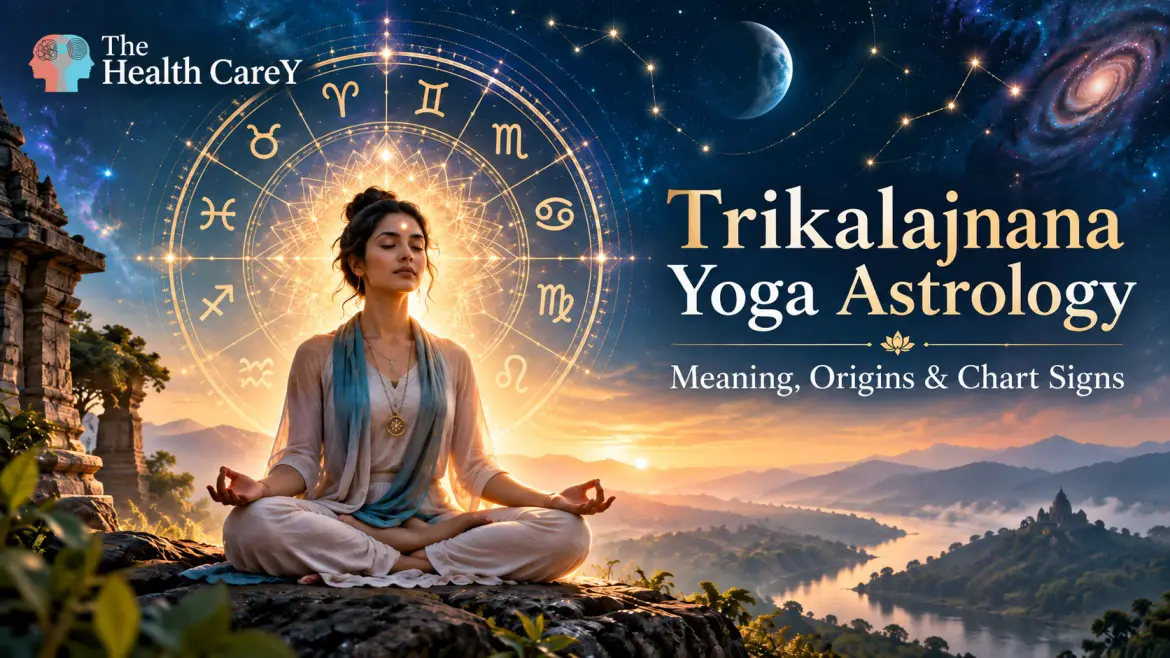
Trikalajnana Yoga astrology is a modern term used for the idea that certain spiritual or astrological conditions may be associated with unusually deep intuition, insight into patterns of time, or what traditional yogic literature describes as knowledge relating to the past and future.
The phrase is closely connected with the Sanskrit idea of trikāla-jñāna.
- Tri means three.
- Kāla means time.
- Jñāna means knowledge or understanding.
Together, trikāla-jñāna can be understood as knowledge of the three dimensions of time—past, present, and future.
The concept appears more clearly in Indian yogic and philosophical traditions than as one universally defined planetary combination in classical astrology.
That distinction matters.
Modern astrology articles sometimes describe “Trikalajnana Yoga” as if there were one fixed birth-chart formula involving Jupiter, the Moon, Mercury, the 5th house, and the 9th house. Those associations may reflect later Jyotisha interpretation, but they should not automatically be presented as a single universally established classical yoga.
A stronger historical starting point is Patanjali’s Yoga Sutra 3.16, which connects samyama on threefold transformation with knowledge of the past and future.
Quick Answer
Trikalajnana Yoga astrology refers to an astrological-spiritual interpretation of trikāla-jñāna, or knowledge relating to past, present, and future.
In yogic literature, especially Patanjali’s Yoga Sutras, knowledge of past and future is discussed as a result of advanced meditative concentration rather than simply as a birth-chart promise.
In modern Vedic astrology, practitioners may examine factors such as:
- Jupiter
- Moon
- Mercury
- 5th house
- 8th house
- 9th house
- 12th house
- Ketu
- Connections between houses of intuition, knowledge, spirituality, and hidden matters
However, there is no single universally agreed chart combination that should automatically be treated as proof that someone can predict the future.
Astrology itself is a traditional belief system rather than an evidence-based method for scientifically predicting future events.
Is “Trikalajnana Yoga Aatrolgoy” the Same Thing?
Yes. Searches such as “trikalajnana yoga aatrolgoy” are usually misspellings of:
Trikalajnana Yoga astrology
You may also see variations such as:
- Trikala Jnana Yoga
- Trikala Gyana Yoga
- Trikalajnana Yoga
- Trikala Jnana astrology
- Trikala Gyana astrology
- Trikala Darshi Yoga
- Trikala Jnana Siddhi
The spelling varies because Sanskrit terms are transliterated into English in different ways.
The more useful concept to understand is trikāla-jñāna, rather than becoming overly focused on one English spelling.
What Does Trikala Jnana Mean?
Trikāla-jñāna broadly refers to knowledge associated with three aspects of time.
These are commonly understood as:
- Past
- Present
- Future
In Indian religious and philosophical traditions, a person described as a trikāla-jñānī or trikālajña may be portrayed as someone possessing extraordinary knowledge extending beyond ordinary perception.
Such descriptions occur in spiritual, devotional, mythological, and philosophical contexts.
They should not automatically be interpreted as scientific claims of literal omniscience.
Trikala Jnana and Patanjali’s Yoga Sutras
One of the most important texts for understanding the underlying idea is Patanjali’s Yoga Sutras.
The third chapter, known as Vibhuti Pada, discusses advanced meditative accomplishments traditionally called siddhis.
Yoga Sutra 3.16 states:
pariṇāma-traya-saṃyamād atītānāgata-jñānam
Traditional translations explain this as knowledge of past and future arising through samyama on threefold transformation.
A translation preserved with classical commentaries explains that through samyama on threefold change, knowledge of the past and future arises. (Yoga Sutra 3.16)
This is important because the sutra does not say:
A particular combination of Jupiter, Moon, Mercury, and house lords automatically gives future knowledge.
Instead, the yogic context emphasizes advanced concentration and meditative discipline.
What Is Samyama?
To understand Yoga Sutra 3.16, you need to understand samyama.
In Patanjali’s system, samyama refers to the combined practice of:
- Dharana — concentration
- Dhyana — meditation
- Samadhi — deep meditative absorption
These are not ordinary concentration exercises.
Within the traditional system, they represent advanced stages of meditative practice.
Yoga Sutra 3.16 connects this deep meditative process with understanding transformation and, according to traditional commentary, knowledge of past and future.
This is very different from claiming that simply having a favorable horoscope makes someone able to see future events.
Is Trikalajnana Yoga Really a Classical Astrology Yoga?
This is where caution is necessary.
The concept of trikāla-jñāna unquestionably exists within broader Indian spiritual vocabulary.
Knowledge of past and future also appears in Patanjali’s Yoga Sutras.
However, the modern internet phrase “Trikalajnana Yoga astrology” is often used more loosely.
Some astrologers interpret certain combinations as indicators of:
- Strong intuition
- Spiritual intelligence
- Insight into hidden causes
- Predictive ability
- Interest in astrology
- Sensitivity to patterns
- Mystical inclination
But different practitioners may propose different combinations.
That means it is better to speak of possible astrological indicators associated with intuitive or spiritual knowledge than to claim one rigid formula defines Trikalajnana Yoga.
Why Jupiter Is Often Associated With Trikala Jnana
In Jyotisha interpretation, Jupiter—Guru or Brihaspati—is traditionally connected with:
- Wisdom
- Teachers
- Philosophy
- Dharma
- Spiritual knowledge
- Higher learning
For this reason, modern astrologers discussing Trikalajnana Yoga often examine Jupiter.
They may look at:
- Jupiter in the 1st house
- Jupiter in the 5th house
- Jupiter in the 9th house
- Jupiter connected with the 5th lord
- Jupiter connected with the 9th lord
- Jupiter influencing the Moon
- Jupiter influencing Mercury
These interpretations belong to astrological tradition.
They should be viewed symbolically rather than as scientifically demonstrated causes of intuition or future knowledge.
Why the 5th House Is Considered Important
The 5th house is often associated in Jyotisha with:
- Intelligence
- Learning
- Creativity
- Memory
- Mantra
- Spiritual merit
- Purva punya, or merit attributed to previous actions or lives in traditional belief
Because of these associations, many astrologers examining spiritual intuition pay close attention to:
- The 5th house
- The 5th-house lord
- Planets placed in the 5th
- Jupiter’s influence on the 5th
- Connections between the 5th and 9th houses
Again, these are traditional astrological interpretations rather than scientifically established mechanisms.
Why the 9th House Is Associated With Higher Knowledge
The 9th house traditionally relates to themes such as:
- Dharma
- Philosophy
- Higher learning
- Teachers
- Spiritual traditions
- Pilgrimage
- Wisdom
- Religious study
A strong connection between the 5th and 9th houses may therefore be interpreted by astrologers as emphasizing:
- Spiritual learning
- Philosophical intelligence
- Scriptural study
- Interest in metaphysical questions
That does not by itself demonstrate clairvoyance.
Does the 8th House Matter?
Some astrologers also consider the 8th house when evaluating intuitive or occult interests.
The 8th house is traditionally associated with:
- Hidden matters
- Transformation
- Mystery
- Research
- Occult subjects
- Secrets
- Sudden change
A strong 8th house may be interpreted as an interest in investigating subjects that are not immediately visible or obvious.
This may explain why astrologers sometimes associate it with:
- Astrology
- Mysticism
- Esoteric studies
- Psychology
- Research
But again, interest in hidden subjects is different from scientifically verified psychic ability.
Why the 12th House Is Often Mentioned
The 12th house is traditionally connected with themes including:
- Withdrawal
- Solitude
- Sleep
- Foreign places
- Spiritual liberation
- Meditation
- Renunciation
Some spiritual astrologers therefore examine the 12th house when interpreting contemplative or mystical tendencies.
Connections among the:
- 5th house
- 8th house
- 9th house
- 12th house
may be interpreted as increasing interest in spiritual or metaphysical subjects.
What Role Does the Moon Play?
In Jyotisha, the Moon is traditionally associated with:
- Mind
- Emotion
- Memory
- Receptivity
- Mental impressions
Astrologers may therefore assess the Moon when discussing intuitive sensitivity.
A Moon influenced by Jupiter, for example, may traditionally be interpreted as supporting:
- Wisdom
- Emotional judgment
- Learning
- Ethical thinking
However, a birth chart should not be used as a substitute for psychological assessment or mental healthcare.
If you are interested in the distinction between emotional experiences and clinical mental health, our guide on what mental health means provides a more evidence-based framework.
What Role Does Mercury Play?
Mercury is traditionally linked with:
- Reasoning
- Communication
- Analysis
- Learning
- Language
- Interpretation
From an astrological perspective, intuition without the ability to interpret information clearly could be difficult to use.
That is why modern interpretations sometimes combine:
- Strong Moon = receptivity
- Strong Mercury = interpretation
- Strong Jupiter = wisdom
This framework is symbolic.
It should not be regarded as a medically or scientifically established model of cognition.
What About Ketu?
Ketu is frequently associated in Vedic astrology with:
- Detachment
- Spirituality
- Past-life themes
- Introspection
- Non-material pursuits
- Mysticism
Some astrologers therefore consider a strong Ketu when interpreting spiritual or intuitive tendencies.
However, interpretations of Ketu vary considerably among different schools of Jyotisha.
It is inaccurate to say that Ketu automatically creates psychic abilities.
Is There One Fixed Trikalajnana Yoga Combination?
No universally accepted combination can responsibly be presented as the single definition.
Online descriptions may include combinations involving:
- Jupiter and Moon
- Jupiter and Mercury
- Jupiter and the 5th lord
- 5th and 9th lords
- Ketu
- 8th or 12th houses
But these vary from author to author.
A better way to understand the concept is:
Trikalajnana Yoga is a label sometimes used by modern astrologers for a pattern of spiritual, intuitive, or predictive indicators rather than one universally standardized classical formula.
Trikalajnana Yoga vs. Gaja Kesari Yoga
These should not be confused.
Gaja Kesari Yoga is traditionally associated with a relationship between Jupiter and the Moon.
It is commonly interpreted in terms of:
- Intelligence
- Reputation
- Wisdom
- Prosperity
- Respect
Trikalajnana interpretations may also involve Jupiter and the Moon, but the concepts are not interchangeable.
Trikalajnana Yoga vs. Budhaditya Yoga
Budhaditya Yoga generally refers to a Sun-Mercury conjunction.
It is traditionally associated with:
- Intellect
- Communication
- Learning
- Analytical ability
Trikalajnana interpretations, by contrast, focus more on:
- Intuition
- Spiritual knowledge
- Understanding patterns of time
- Mystical perception
They represent different astrological ideas.
Trikalajnana Yoga vs. Saraswati Yoga
Saraswati Yoga is traditionally linked with:
- Knowledge
- Learning
- Arts
- Speech
- Scholarship
Modern Trikalajnana interpretations focus more specifically on spiritual insight or knowledge extending beyond ordinary temporal understanding.
A person may be intellectually gifted without claiming knowledge of future events.
Trikalajnana Yoga vs. Jnana Yoga
This distinction is especially important.
Jnana Yoga is a major philosophical-spiritual path concerned with knowledge, self-inquiry, and realization.
It is not simply a horoscope combination.
Trikalajnana Yoga astrology, on the other hand, is a modern astrological framing around the idea of knowledge across time.
The similarity in names should not cause these concepts to be merged.
Trikala Jnana and Siddhis
Patanjali’s third chapter discusses extraordinary accomplishments or siddhis associated with advanced yogic concentration.
Traditional descriptions include unusual forms of knowledge and perception.
Yoga Sutra 3.16 specifically associates samyama on threefold transformation with knowledge relating to past and future. (Yoga Sutra 3.16 with classical commentaries)
This places the idea in the context of advanced yogic practice, not casual horoscope reading.
Did Patanjali Teach Astrology?
The Yoga Sutras are primarily a text about:
- Yoga
- Meditation
- Mental discipline
- Liberation
- Consciousness
They are not an astrology manual.
Using Yoga Sutra 3.16 to support the existence of the broader concept of knowledge of past and future is reasonable.
Using it as direct evidence for a particular planetary formula is much harder to justify.
That distinction is often missing from online articles.
Can Trikalajnana Yoga Predict the Future?
Astrological traditions may claim that certain individuals have exceptional predictive ability.
Scientific research has not established astrology as a reliable method for predicting specific future events.
Therefore, birth-chart interpretations should not be used as the sole basis for:
- Medical decisions
- Financial decisions
- Legal decisions
- Mental health treatment
- Major safety decisions
Astrology can be approached as:
- Cultural tradition
- Spiritual practice
- Symbolic reflection
- Personal belief
rather than a scientifically validated prediction system.
Does Trikalajnana Yoga Make Someone Psychic?
There is no scientific test establishing that a specific birth-chart pattern makes someone psychic.
People may describe experiences such as:
- Strong intuition
- Vivid dreams
- Déjà vu
- Accurate guesses
- Unusual pattern recognition
But these experiences do not prove supernatural foresight.
Memory, probability, pattern recognition, expectation, confirmation bias, and selective recall can all influence how people interpret apparently predictive experiences.
What About Prophetic Dreams?
Some people report dreams that later seem connected with real events.
Traditional spiritual systems may interpret these experiences in metaphysical terms.
Modern psychology generally approaches dreams differently and does not treat them as reliable evidence of future prediction.
A vivid dream can still feel personally meaningful without proving that it predicted an event.
Why Do People Feel They Can “Sense” Future Events?
Human brains are highly effective at detecting patterns.
Sometimes we unconsciously notice small cues before we consciously understand them.
This can create a strong intuitive feeling.
For example, someone may sense that:
- A relationship is changing
- A business situation is unstable
- Another person is upset
- A familiar environment feels different
The feeling can seem mysterious even when subtle observations contributed to it.
Spiritual traditions may interpret intuition differently.
These perspectives can coexist as different frameworks, but they should not be presented as identical forms of evidence.
Is Trikalajnana Yoga Related to Meditation?
The traditional yogic connection is much stronger than the purely astrological one.
Patanjali’s Yoga Sutras connect extraordinary forms of knowledge with samyama, an advanced meditative discipline.
Modern yoga research also supports some more ordinary benefits of yoga and meditation.
The National Center for Complementary and Integrative Health notes that yoga may help with:
- Stress management
- General well-being
- Sleep
- Balance
- Some anxiety or depressive symptoms
These documented wellness effects should not be confused with scientific evidence for predicting the future.
Can Meditation Improve Intuition?
Meditation can improve qualities such as:
- Attention
- Awareness
- Emotional regulation
- Observation of thoughts
- Present-moment awareness
The National Center for Complementary and Integrative Health notes that mindfulness and meditation have been studied for anxiety, depression, sleep, pain, and other outcomes.
Improved attention may make someone more aware of subtle cues.
That is different from proving supernatural foresight.
Trikalajnana Yoga and Mental Well-Being
Spiritual practices can be meaningful sources of:
- Reflection
- Identity
- Community
- Purpose
- Calm
But spiritual explanations should not replace appropriate care when someone experiences significant mental-health symptoms.
For example, persistent:
- Anxiety
- Insomnia
- Paranoia
- Hallucinations
- Severe mood changes
- Confusion
- Loss of functioning
deserve appropriate professional evaluation.
Our guide to clinical mental health counseling explains what professional mental-health assessment and counseling can involve.
Can Yoga Support Mental Health?
Yoga may support well-being, although it is not a replacement for necessary medical or psychological treatment.
According to the National Center for Complementary and Integrative Health, research suggests yoga may help with stress management and may improve some aspects of mental and emotional well-being.
If you use yoga as part of a wellness routine, think of it as complementary rather than as proof of supernatural abilities.
How Modern Astrologers May Examine a Chart
A practitioner exploring Trikalajnana-style themes might consider the chart in stages.
1. Assess Jupiter
They may examine:
- Sign
- House
- Aspects
- Conjunctions
- Strength
- Connections with spiritual houses
2. Examine the 5th House
Questions may include:
- Which planet rules it?
- Where is the ruler placed?
- Does Jupiter influence it?
- Is it connected with the 9th house?
3. Examine the 9th House
This may be interpreted in connection with:
- Teachers
- Dharma
- Higher education
- Spiritual study
4. Examine the Moon
The Moon may be interpreted in relation to:
- Emotional receptivity
- Mental stability
- Memory
- Intuition
5. Examine Mercury
Mercury may represent:
- Logical interpretation
- Communication
- Discernment
6. Examine Ketu and the 12th House
These may be interpreted as indicators of:
- Detachment
- Meditation
- Spirituality
- Inner life
7. Consider the Entire Horoscope
Astrologers generally interpret combinations within the whole chart rather than isolating one placement.
Even within astrology, a single planetary position rarely has one guaranteed outcome.
Do Dashas Activate Trikalajnana Yoga?
Some Jyotisha practitioners believe a potential indicated in the natal chart may become more noticeable during relevant planetary periods known as dashas.
For example, an astrologer might pay attention to periods involving:
- Jupiter
- Moon
- Mercury
- Ketu
- 5th lord
- 9th lord
However, there is no scientifically validated evidence that dashas activate clairvoyant ability.
This belongs to traditional astrological interpretation.
Do Transits Activate It?
Some astrologers also study transits, especially Jupiter’s movement relative to:
- Natal Moon
- Jupiter
- 5th house
- 9th house
Again, such interpretations belong to astrology rather than established science.
Is Trikalajnana Yoga Rare?
It is often described online as rare.
But this statement is difficult to quantify because there is no universally accepted formula defining it.
Without a standardized definition, no meaningful percentage of people can be said to possess it.
This is another reason to be cautious with statements such as:
“Only one in a million charts contains Trikalajnana Yoga.”
There is no reliable basis for such precise claims.
Can You Develop Trikala Jnana Through Practice?
Traditional yogic literature places much more emphasis on practice than on horoscope combinations.
The Yoga Sutras emphasize:
- Concentration
- Meditation
- Self-discipline
- Ethical practice
- Detachment
- Samadhi
rather than merely being born with special planetary placements.
From a traditional yogic perspective, spiritual development is therefore primarily connected with disciplined practice.
Does Practicing Yoga Guarantee Siddhis?
No.
Even within traditional yoga philosophy, spiritual practice should not be reduced to chasing unusual powers.
The broader aim of classical yoga is liberation and transformation of consciousness.
Modern practitioners should also avoid extreme breathing, fasting, or meditation practices undertaken specifically to force unusual experiences.
Yoga is generally considered safe when practiced appropriately, but the NCCIH recommends appropriate instruction because injuries can occur.
Common Misconceptions About Trikalajnana Yoga
Myth 1: One planetary combination proves future sight
There is no universally established classical rule that scientifically proves this.
Myth 2: A strong Jupiter makes someone psychic
Jupiter has symbolic associations with wisdom in Jyotisha, but a strong Jupiter does not scientifically establish clairvoyance.
Myth 3: Vivid dreams always predict future events
Dreams can feel meaningful without reliably predicting the future.
Myth 4: Trikala Jnana is simply an astrology technique
Its deeper roots are strongly connected with yogic and spiritual ideas about knowledge and consciousness.
Myth 5: Meditation guarantees supernatural abilities
Meditation has documented effects on attention and well-being, but supernatural predictions have not been scientifically established.
Myth 6: Having spiritual experiences means someone does not need mental-health care
Spirituality and healthcare are not mutually exclusive.
Persistent psychological distress should be evaluated appropriately.
Trikalajnana Yoga Astrology at a Glance
| Question | Short Answer |
|---|---|
| What does Trikala mean? | Three times: past, present, future |
| What does Jnana mean? | Knowledge or understanding |
| Is Trikala Jnana mentioned in yogic tradition? | The broader concept is supported by yogic texts |
| Does Patanjali mention knowledge of past and future? | Yes, Yoga Sutra 3.16 discusses it in relation to samyama |
| Is there one universally accepted astrology combination? | No |
| Is Jupiter often considered? | Yes, in modern Jyotisha interpretation |
| Are the 5th and 9th houses considered? | Often |
| Can astrology scientifically prove future knowledge? | No |
| Is meditation connected with the traditional concept? | Yes, much more directly than a simple birth-chart formula |
| Does yoga have evidence-based health benefits? | Some benefits for stress and well-being are supported by research |
What Makes a Responsible Interpretation?
A responsible discussion of Trikalajnana Yoga should separate three different things.
Traditional philosophy
Texts such as Patanjali’s Yoga Sutras discuss extraordinary forms of knowledge within advanced yogic practice.
Astrological interpretation
Modern Jyotisha practitioners may interpret planetary placements symbolically in relation to intuition and spiritual development.
Scientific evidence
Science has not established natal astrology as a reliable tool for predicting specific future events.
Keeping these categories separate makes the subject easier to understand without dismissing its cultural or spiritual significance.
The Bottom Line
Trikalajnana Yoga astrology is best understood as a modern astrological interpretation built around the older Sanskrit concept of trikāla-jñāna—knowledge across time.
The most relevant classical yogic reference is Patanjali’s Yoga Sutra 3.16, which describes knowledge of past and future arising through samyama on threefold transformation.
That textual foundation is much clearer than claims that one specific planetary combination automatically produces supernatural foresight.
In modern Jyotisha, astrologers may examine:
- Jupiter
- Moon
- Mercury
- Ketu
- 5th house
- 8th house
- 9th house
- 12th house
- Connections among these planets and houses
to interpret spiritual intelligence, intuition, contemplation, or interest in hidden knowledge.
But there is no universally agreed Trikalajnana Yoga formula, and astrology has not been scientifically validated as a method for reliably predicting future events.
The most historically grounded interpretation therefore combines:
yogic philosophy + traditional symbolism + careful distinction between belief and scientific evidence.
For someone interested in the spiritual aspect, Patanjali’s discussion of samyama provides a deeper starting point than simply searching for a rare planetary combination.
For someone interested in yoga for health and well-being, evidence-based resources such as the National Center for Complementary and Integrative Health provide a clearer picture of what modern research does—and does not—support.
Frequently Asked Questions
What is Trikalajnana Yoga astrology?
Trikalajnana Yoga astrology is a modern term used for astrological interpretations connected with trikāla-jñāna, meaning knowledge relating to past, present, and future. Modern astrologers may look for combinations involving Jupiter, the Moon, Mercury, Ketu, and houses associated with wisdom, intuition, and spirituality.
What does Trikala Jnana mean?
Trikāla-jñāna broadly means knowledge of the three dimensions of time: past, present, and future.
Is Trikalajnana Yoga mentioned in the Yoga Sutras?
The exact modern phrase “Trikalajnana Yoga astrology” is not the main formulation in Patanjali’s Yoga Sutras. However, Yoga Sutra 3.16 states that samyama on threefold transformation leads to knowledge of past and future.
Which planets are associated with Trikalajnana Yoga?
Modern astrologers often discuss Jupiter, Moon, Mercury, and Ketu, along with the 5th, 8th, 9th, and 12th houses. There is no single universally accepted formula.
Is Jupiter important for Trikala Jnana?
Jupiter is traditionally associated with wisdom, philosophy, teachers, and higher knowledge in Jyotisha, so it commonly appears in modern interpretations of spiritual or knowledge-related yogas.
Which house is most important for Trikalajnana Yoga?
There is no universally agreed single house. The 5th and 9th houses are frequently emphasized, while some astrologers also consider the 8th and 12th houses.
Does Trikalajnana Yoga mean you can predict the future?
Traditional interpretations may associate it with unusual intuition or knowledge, but astrology has not been scientifically established as a reliable method for predicting specific future events.
Is Trikala Jnana the same as psychic ability?
Not exactly. Trikala Jnana is a traditional spiritual concept concerning knowledge across time. Modern descriptions may connect it with psychic ability, but those claims are not scientifically established.
Can meditation develop Trikala Jnana?
Patanjali’s Yoga Sutras connect knowledge of past and future with advanced samyama, which combines concentration, meditation, and meditative absorption. This is a traditional yogic claim rather than a scientifically demonstrated method for seeing the future.
Is Trikalajnana Yoga the same as Jnana Yoga?
No. Jnana Yoga is a major spiritual path centered on knowledge and self-inquiry. Trikalajnana Yoga astrology is a modern term concerning knowledge across time and possible astrological indicators.
Is Trikalajnana Yoga rare?
It is often described as rare, but there is no standardized definition that would allow its actual frequency to be measured reliably.
Is “trikalajnana yoga aatrolgoy” a different concept?
No. “Trikalajnana yoga aatrolgoy” is generally a misspelling of “Trikalajnana Yoga astrology.” Other spellings include Trikala Jnana Yoga, Trikala Gyana Yoga, and Trikala Jnana astrology.