
In modern healthcare, precision and reliability are critical when administering medications. Whether used in hospitals, clinics, laboratories, or home-care settings, syringes play an essential role in ensuring drugs are delivered safely and effectively. While many people view a syringe as a simple medical device, its design and construction can significantly influence treatment outcomes. Understanding how different syringe components affect drug delivery performance is important for healthcare professionals, pharmaceutical manufacturers, and medical device developers alike.
The Importance of Syringe Design
Drug delivery performance refers to the accuracy, consistency, and effectiveness with which a medication reaches the patient. A well-designed syringe helps ensure that the correct dose is administered while minimising waste, contamination, and patient discomfort. Each part of the syringe contributes to its overall functionality, making the quality and compatibility of syringe components a crucial consideration.
Even small variations in materials, dimensions, or manufacturing processes can impact how a syringe performs. As pharmaceutical formulations become increasingly complex, the role of syringe design continues to grow in importance.
Barrel Material and Drug Compatibility
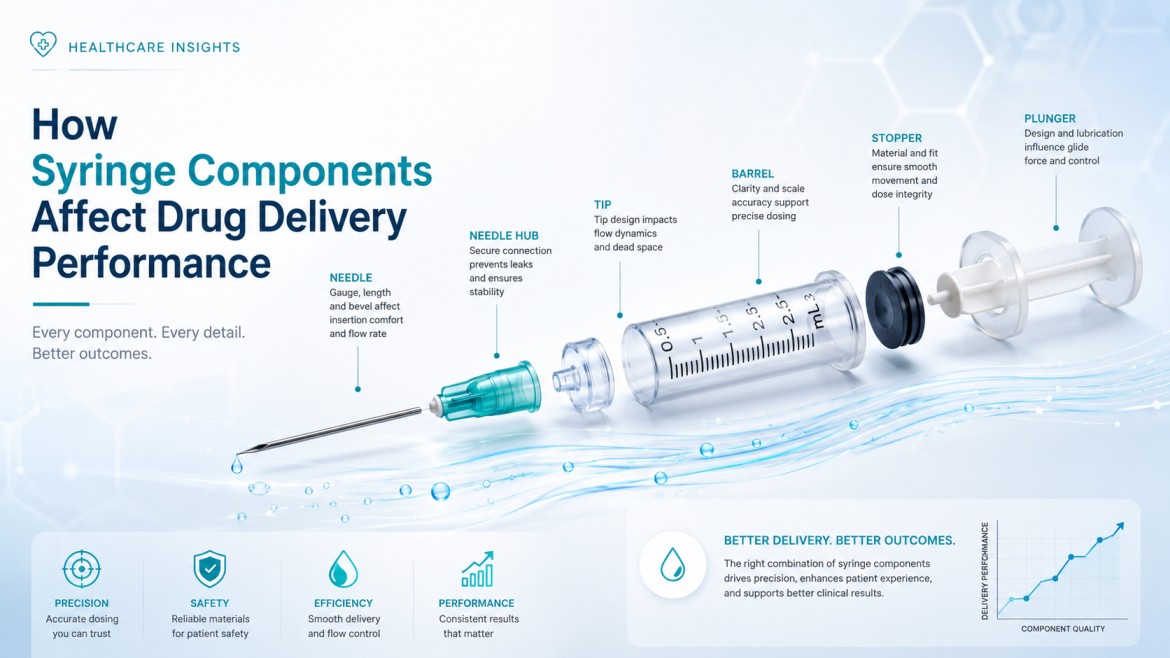
The syringe barrel is the main chamber that holds the medication before administration. It is commonly manufactured from glass or medical-grade plastic. The choice of material can have a direct impact on drug stability and delivery performance.
Glass barrels are often preferred for sensitive biologic drugs because they offer excellent chemical resistance and minimise interactions with the medication. Plastic barrels, on the other hand, are lightweight, durable, and less prone to breakage. However, certain medications may interact with plastic materials, potentially affecting drug potency or purity over time.
Manufacturers must carefully evaluate compatibility between the medication and syringe materials to prevent degradation, contamination, or reduced therapeutic effectiveness.
The Role of the Plunger and Stopper
The plunger and stopper work together to create a seal inside the barrel, allowing medication to be drawn into and expelled from the syringe. These syringe components play a major role in determining dosing accuracy and injection smoothness.
A properly designed stopper helps prevent leakage while ensuring consistent movement during injection. If the stopper creates excessive friction against the barrel, users may experience increased force requirements, making administration more difficult. Conversely, insufficient sealing can lead to inaccurate dosing or medication loss.
Many stoppers are manufactured from elastomeric materials and coated with lubricants to optimise performance. However, manufacturers must carefully control these coatings to avoid interactions with sensitive drug formulations.
Needle Design and Delivery Efficiency
The needle is another critical element influencing drug delivery performance. Factors such as needle gauge, length, wall thickness, and tip design can affect both medication flow and patient experience.
A larger internal diameter allows medication to flow more easily, reducing injection force requirements. However, larger needles may cause greater discomfort during administration. Ultra-thin wall needle technology has become increasingly popular because it allows higher flow rates while maintaining a smaller external diameter.
Needle sharpness also contributes to patient comfort and injection efficiency. Well-designed needles minimise tissue trauma, helping improve the overall treatment experience and encouraging patient adherence to prescribed therapies.
Lubrication and Injection Consistency
Lubrication is often applied to various syringe components to ensure smooth operation. Silicone oil is commonly used to reduce friction between the stopper and barrel. This helps maintain consistent glide force and improves ease of use.
However, excessive silicone oil can create particles or droplets that may interact with certain pharmaceutical products, particularly biologics and protein-based medications. These interactions may contribute to aggregation or reduced product stability.
As a result, manufacturers are increasingly exploring alternative lubrication technologies and low-silicone designs to balance functionality with drug compatibility.
Dead Space and Dose Accuracy
Dead space refers to the small volume of medication that remains trapped within the syringe after the plunger is fully depressed. While this volume may seem insignificant, it can have a meaningful impact on dose accuracy, especially when administering high-value biologics or low-volume medications.
Reducing dead space helps maximise drug delivery efficiency and minimise waste. This is particularly important in vaccination programmes and treatments involving expensive specialty drugs. Modern syringe designs often focus on optimising internal geometry to minimise residual volume and improve dosing precision.
Manufacturing Quality and Performance Reliability
The performance of a syringe depends not only on its design but also on the quality of its manufacturing process. Tight dimensional tolerances help ensure consistent performance across production batches. Variations in barrel dimensions, stopper fit, or needle attachment can affect injection force, leakage resistance, and dosing accuracy.
Regulatory standards require rigorous testing of syringe components to verify safety, reliability, and compatibility with pharmaceutical products. Manufacturers invest heavily in quality control measures to ensure every syringe performs as intended throughout its shelf life.
In short
Syringes are far more sophisticated than they may appear at first glance. Every aspect of their design, from the barrel material and stopper construction to needle geometry and lubrication systems, can influence drug delivery performance. High-quality syringe components help ensure accurate dosing, maintain drug stability, improve patient comfort, and support positive treatment outcomes.
As pharmaceutical therapies continue to evolve, the demand for advanced syringe technologies will only increase. By understanding the role of syringe components in drug delivery, healthcare providers and manufacturers can make informed decisions that enhance both patient safety and therapeutic effectiveness.